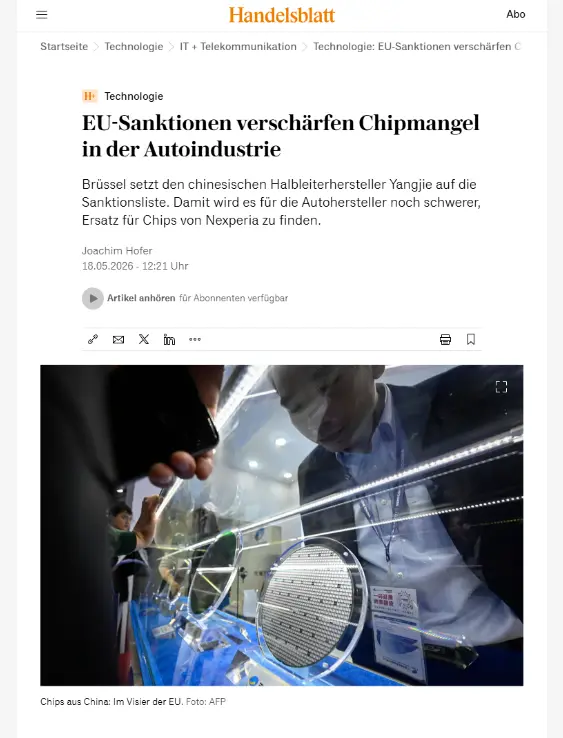
"EU sanctions exacerbate chip shortage in the automotive industry"
Brussels places the Chinese semiconductor manufacturer Yangjie on the sanctions list. This will make it even more difficult for car manufacturers to find replacements for Nexperia chips.
Munich. Chip supply is once again becoming more difficult for Germany's automotive industry. The EU is taking action against the Chinese chip manufacturer Yangzhou Yangjie Electronic Technology (Yangjie). Brussels is thus exacerbating the situation for the companies, which had recently relied on new sources of supply.
The war in the Gulf is making energy more expensive for chip factories in the Far East and therefore for semiconductors. Blocked transport routes are putting additional pressure on industrial customers. How can this be remedied?
Munich. Customers in the semiconductor industry are facing a new price shock due to the war in the Middle East. Experts assume that chip manufacturers will quickly pass on the sharp rise in energy, material and logistics costs.
Many industrial companies have not yet fully come to terms with the last chip crisis, but the next one is already building up. Rising prices, significantly longer delivery times and stricter delivery conditions show that the supply situation is coming to a head again. While the market appears stable at first glance, structural risks along the supply chain are intensifying in the background. Simple but essential components are particularly affected, as they can suddenly become a critical weak point.
From a procurement perspective, the current development is no coincidence, but the result of a typical market cycle, which this time is being exacerbated by additional factors such as geopolitical tensions, rising costs and structural shifts in the semiconductor market. During the chip crisis in the pandemic, many industrial companies ordered significantly larger quantities of semiconductors in order to avoid production risks.
"New chip crisis hits German industry with full force"
Delivery times have stretched from eight weeks to almost a year. Many companies are now taking revenge for the fact that they have hardly any stocks of semiconductors - despite warnings from prominent sources.
Munich. The German industry is once again struggling for chips. „The usual delivery time of eight weeks has risen to 50 weeks for some products,“ says Noureddine Seddiki, head of the Frankfurt-based electronics broker Sand & Silicon. Some semiconductor manufacturers are no longer accepting new customers at all.
"Warning of new chip crisis: Automotive and defense industries particularly affected"
German industry could be facing a new chip crisis. According to a report in the „Handelsblatt“ newspaper, there are warnings of supply bottlenecks for computer chips, on which German car manufacturers in particular, but also the defense industry, are dependent.
„There will be a shortage of chips again for the first time in the fourth quarter,“ the business newspaper quotes Tanjeff Schadt from the consulting firm Strategy&. „Next year, the supply gap will be even bigger.“ The automotive and defense industries, as well as medical technology companies in Germany, could be particularly affected, as these sectors have relied on older technologies for too long. „These chips are now becoming scarce,“ says consultant Schadt.
Whether it's for cars, workstations or medicine, there's one thing that the current industry is constantly heavily reliant on: Chips. When companies struggle with supply bottlenecks here, they turn to brokers. One of them is Noureddine Seddiki, who founded SAND & SILICON in 2020. His startup procures scarcely available semiconductor parts and is thus an important part of a flourishing industry.
When procuring highly complex electronic parts via third parties, trust is the top item on the checklist. As a rule, young companies have to work hard for years to earn this trust. Two and a half years after its founding, Seddiki's customers already include global players in the automotive, medical technology and electrical industries.
This has mainly to do with the network in which buyers of the companies and brokers operate: Here, the trading of the commodity runs enormously fast and if a broker does a reliable job, he benefits from recommendations between the customers. These then support each other in emergency situations, such as shortages.
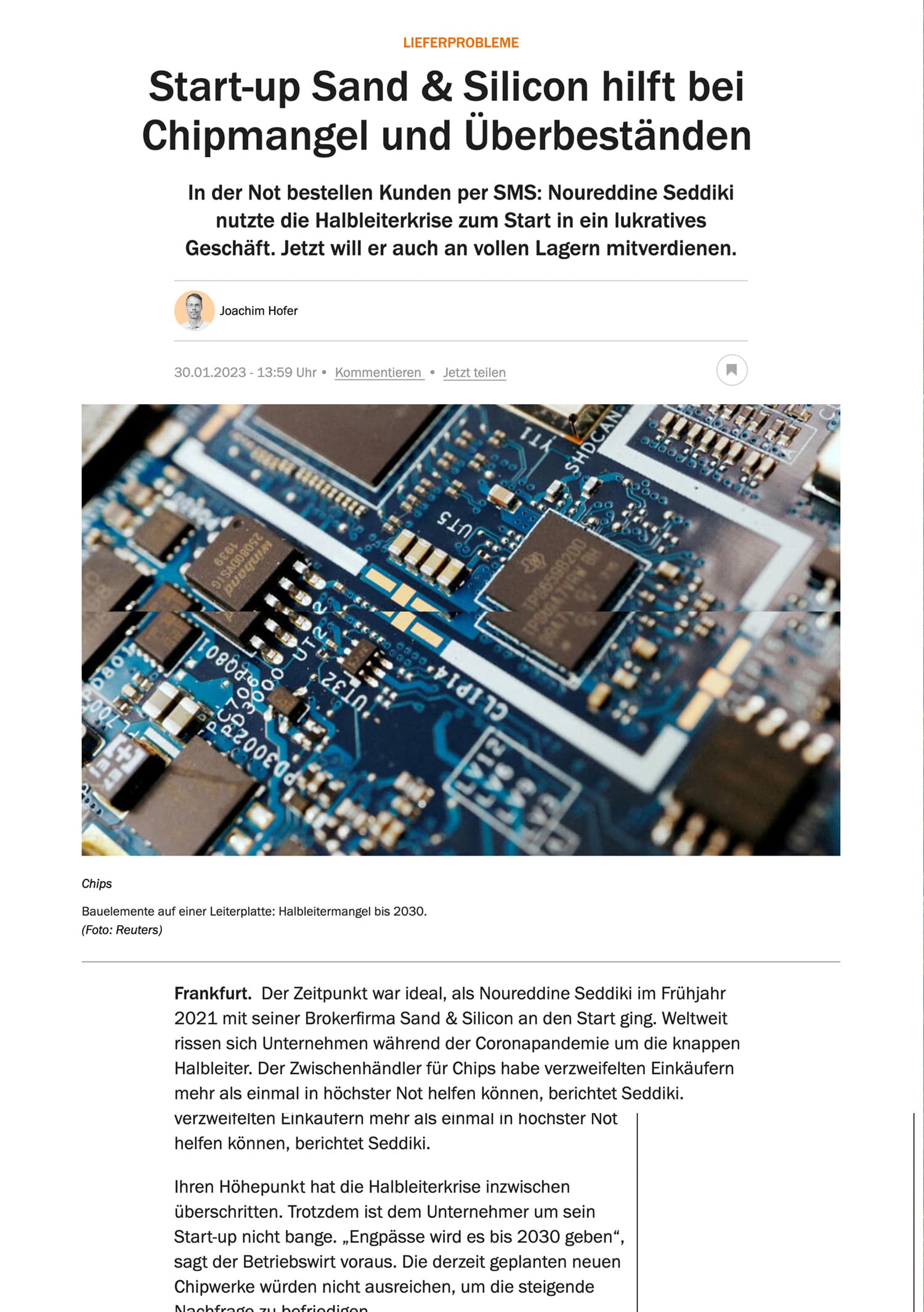
"Startup Sand & Silicon helps with chip shortages and overstocks"
In times of need, customers order by text message: Noureddine Seddiki used the semiconductor crisis to launch a lucrative business. Now he also wants to earn money from full warehouses.
The timing was ideal when Noureddine Seddiki launched his brokerage firm Sand & Silicon in the spring of 2021. Companies worldwide were scrambling for scarce semiconductors during the corona pandemic. The intermediary for chips was able to help desperate buyers in the greatest need more than once, Seddiki reports.
The semiconductor crisis has now passed its peak. Nevertheless, the entrepreneur is not worried about his start-up. "There will be bottlenecks until 2030," predicts the business economist. The new chip plants currently planned would not be enough to satisfy the rising demand. There is something else that makes Seddiki, a native of Frankfurt, confident: He also earns money from full warehouses. The 38-year-old helps companies turn excess stocks into cash...
“Warehouses overcrowded – electronics companies threatened with many bankruptcies”
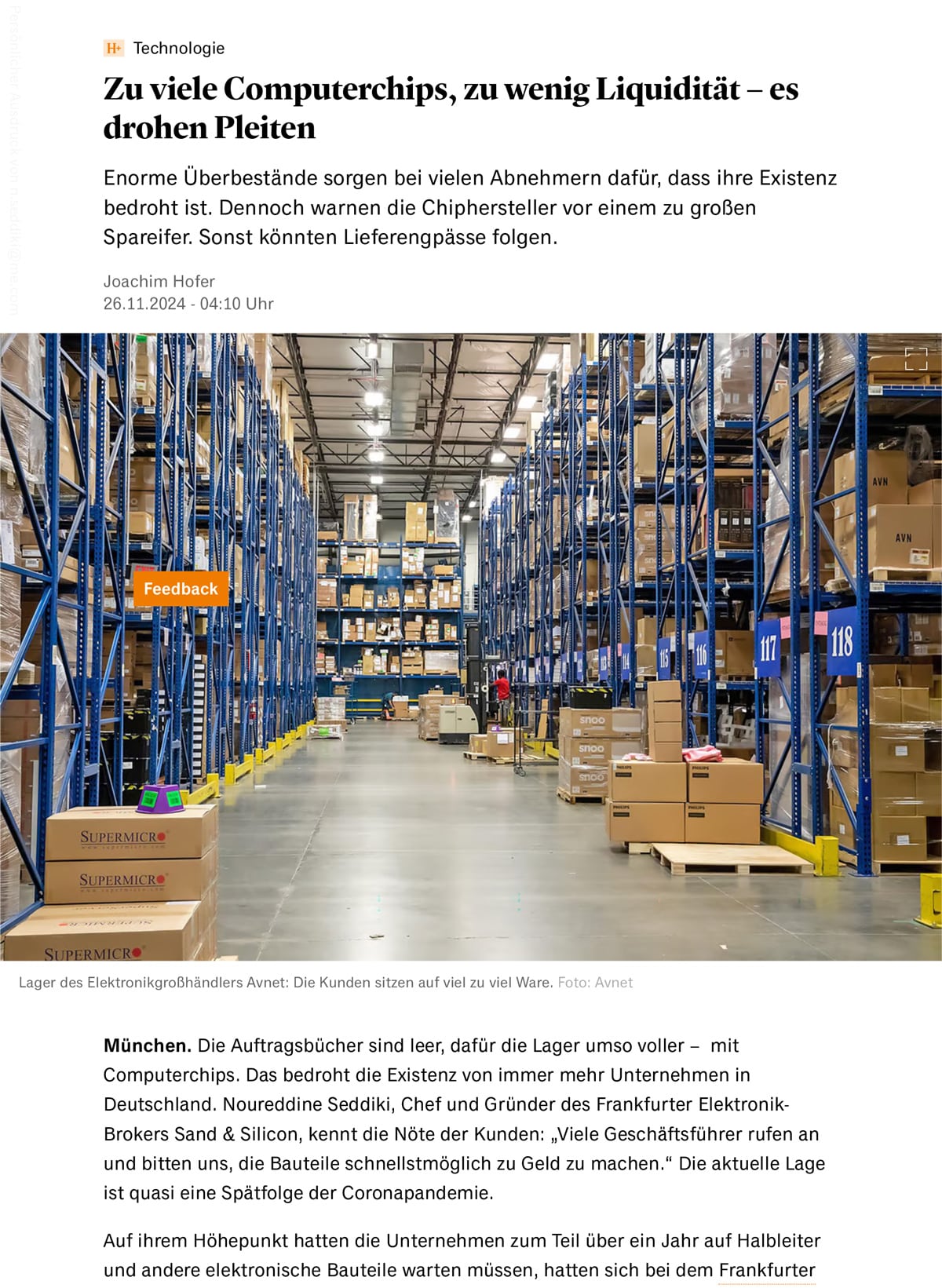
Enormous excess stocks mean that the existence of many customers is threatened. Nevertheless, chip manufacturers warn against being too keen to save money. Otherwise, supply bottlenecks could follow.
Munich. The order books are empty, but the warehouses are all the more full - with computer chips. This is threatening the existence of more and more companies in Germany. Noureddine Seddiki, CEO and founder of the Frankfurt-based electronics broker Sand & Silicon, knows the needs of customers: "Many managers call and ask us to turn the components into money as quickly as possible." The current situation is essentially a late consequence of the corona pandemic.
"Overstocks in many places, but
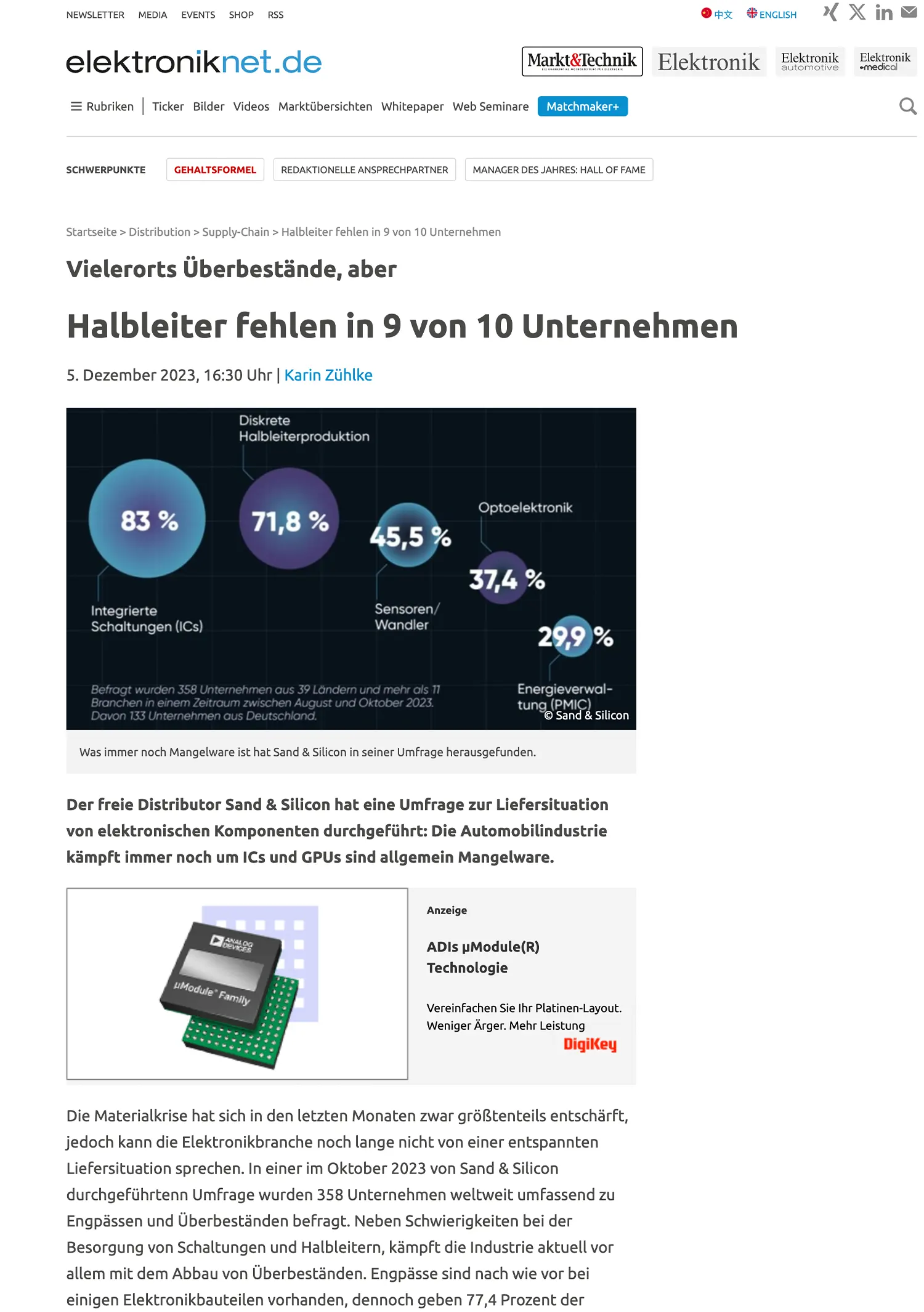
Semiconductors are missing in 9 out of 10 companies"
The independent distributor Sand & Silicon has conducted a survey on the supply situation of electronic components: The automotive industry is still struggling for ICs and GPUs are generally in short supply.
Although the materials crisis has largely eased in recent months, the electronics industry is still far from being able to speak of a relaxed supply situation. In a survey conducted by Sand & Silicon in October 2023, 358 companies worldwide were comprehensively questioned about bottlenecks and overstocks. In addition to difficulties in procuring circuits and semiconductors, the industry is currently struggling to reduce excess inventories. Bottlenecks still exist for some electronic components, but 77.4% of companies state that the supply situation has generally eased. For example, the procurement of passive components (34.6%) and connectors (19%) is much more relaxed than a few months ago...
"Supply bottlenecks - How brokers get hold of scarce components"
Sand & Silicon is a broker. While brokers were often associated negatively in the past, their reputation has changed: Because brokers saved the revenue of many companies in the last two years.
While much of the economy went into short-time work in 2020, ushering in the time for the materials crisis, Noureddine Seddiki launched his company: an independent distributor called Sand & Silicon. Sand & Silicon set out with the goal of becoming the best customer service and support provider in the market.
Sand & Silicon is a broker. What was once often negatively associated has saved many companies sales in the last two years. "People always think we sell expensive fake products - but we often spend days organizing hard-to-find parts on the world market to ensure production," explains Noureddine Seddiki. And with success: Starting with 20 companies in the DACH region, Sand & Silicon now supports over 500 companies worldwide. In order to maintain proximity to customers and suppliers from Asia...
"Buyers can take precautions with these strategies"
Companies are still faced with material shortages. An additional challenge is the reduction of excess inventories. In order to define a smart strategy for one's company here, it is worth taking a look at the forecasts - which parts are in particular demand and where the situation will increasingly ease.
Recent years have shown that the supply situation can change in just a short time. This complicates dit planning and, in the worst-case scenario, leads to the fact that the assembly lines come to a standstill. The highest level of commitment and creativity was required from buyers and supply chain managers.
Currently, global supply chains seem to be recovering. In turn, however, there are parts and assemblies on the horizon for which the supply situation is not certain and others for which the situation will come to a head again. In addition, Europe's dependence on Asia is still a flashpoint that cannot be solved in the medium, if not long term.
Nvidia is achieving dream results with its specialty chips. That's because AI semiconductors are expensive and in short supply - which puts startups and companies in a bind.
Munich, Dusseldorf, San Francisco. When Mustafa Suleyman is asked at a tech conference in San Francisco what makes his startup Inflection AI so special, he doesn't have to think twice. "We have the largest cluster of Nvidia's powerful chips," says the artificial intelligence (AI) expert. One has 22,000 of the semiconductors, he says. "That's a huge advantage."
The statement is remarkable. Suleyman once founded the pioneer Deepmind, which now belongs to Google. But instead of touting his new business model or his AI assistant, the 39-year-old prefers to talk about semiconductors. Because they're expensive and hard to come by. "Everyone is after AI chips," says David DeSanto, head of product at tech company Gitlab.
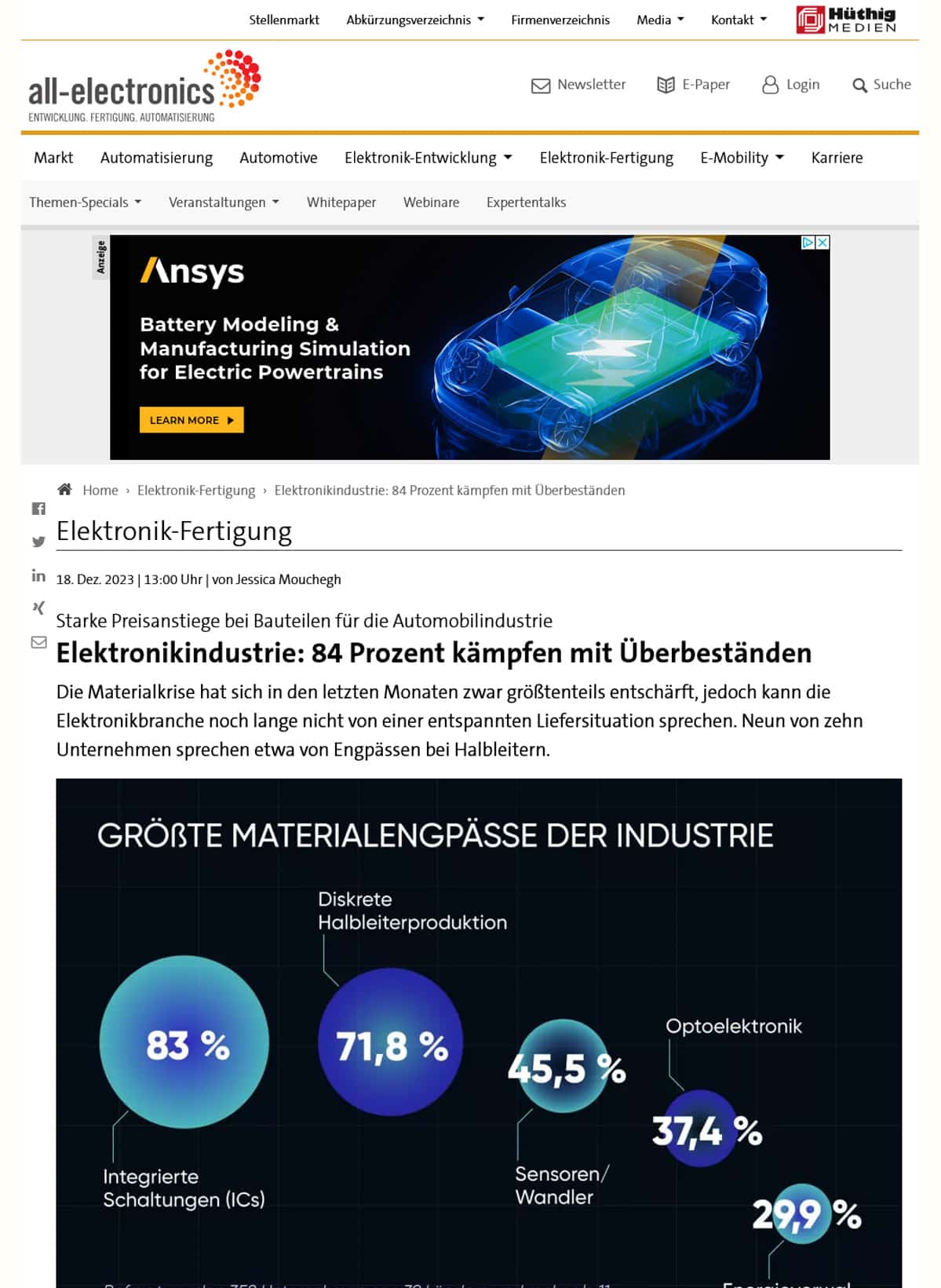
"Electronics Industry: 84 Percent Struggle with Surpluses"
The material crisis has largely eased in recent months, but the electronics industry is still far from experiencing a relaxed supply situation. Nine out of ten companies, for instance, report shortages of semiconductors.
In an October 2023 survey, the Frankfurt-based company Sand & Silicon comprehensively interviewed 358 companies worldwide about shortages and surpluses (Request the study). In addition to challenges in sourcing circuits and semiconductors, the industry is currently struggling primarily with reducing surpluses. While shortages persist for certain electronic components, 77.4 percent of companies report that the overall supply situation has improved.
The procurement of passive components (34.6%) and connectors (19%) has become significantly easier compared to a few months ago. However, more than 9 out of 10 companies report that the supply situation in the areas of optoelectronics, battery products, and discrete semiconductor production remains tense. The electronics industry anticipates price increases for integrated circuits (74.9%) and discrete semiconductor production (66.5%). In contrast, price reductions are expected primarily for passive components. Additionally, a majority of companies feel prepared for the next material crisis: 51.4% consider themselves well-prepared, while 40.8% feel at least partially prepared.
"Full Warehouses, Empty Coffers: Chip Crisis Hits Electronics Industry Hard"
After years of chip shortages, companies are now grappling with massive surpluses. Bankruptcies loom, while chip manufacturers warn of a new wave of shortages. How did it come to this?
The party is over – now the problems begin.
Just a few years ago, computer chips were in short supply. Automakers halted production, and electronics companies faced months-long delays for replenishment. The solution for many companies: panic buying. Components were ordered in multiples – no matter the cost.
Today, many companies face the next crisis. Warehouses are overflowing, and order books are empty. “We see companies every day trying to monetize their surpluses as quickly as possible,” says Noureddine Seddiki, CEO of the Frankfurt-based electronics broker Sand & Silicon.
His team trades surplus components globally. However, not all companies are fortunate enough to clear their warehouses quickly. Experts like Franz-Xaver Feiner from the electronics service provider Zollner warn: “We are facing a market shakeout.” Translation: Some companies will go bankrupt.
Why so many chips?
The origin of this chaos lies in the COVID-19 pandemic. Amid the global production halt, semiconductors became highly sought-after. The fear of running out led companies to take extraordinary measures.
The majority of our employees were formerly employed by leading global manufacturers, distributors and brokers. They are professionals from different backgrounds in terms of their expertise as well as their nationalities and now form a high-performance team that has an absolute overall view of supplier structures and working methods on the global market.This bundled expertise naturally flows into our consulting.
Oliver Sand // Head of Operations
General request
You want to get in direct contact with us?
LinkedIn
Visit and follow us now on LinkedIn to never miss a thing
Schauen Sou like to take a look at our Unterprise presentation to
Take a look at our company presentation
Feel free to take a look at our corporate presentation to
In this company presentation we have clearly presented the most important components and services of our company for you and reduced everything as far as possible to the essentials. If you would like a personal presentation, please do not hesitate to contact us and we will calmly discuss all further details.